
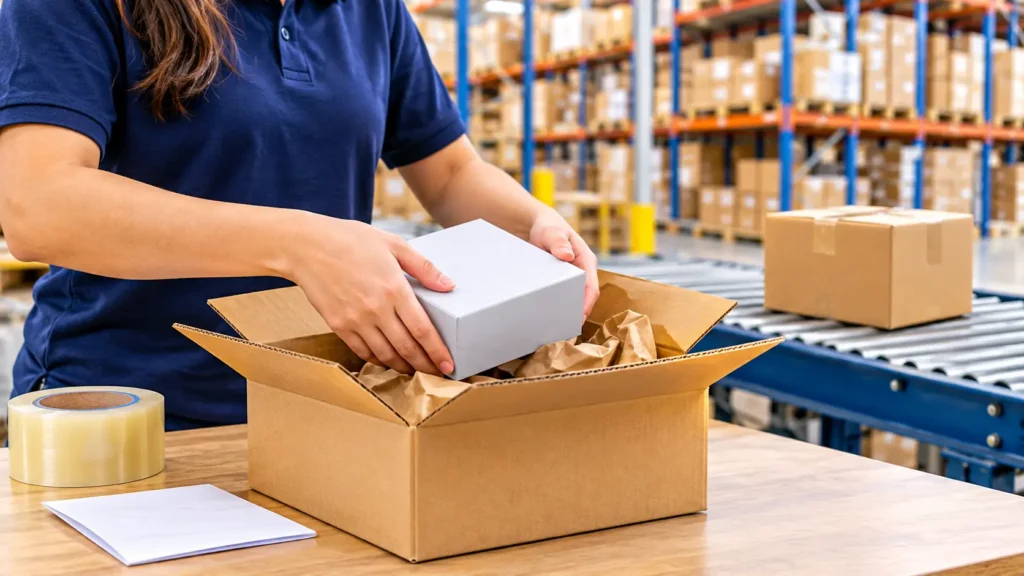
DTC fulfillment services take over everything that happens after a customer clicks “buy” on your own store. A warehouse stores your inventory, picks and packs each order, hands it to a carrier, and handles the return if one comes back. Most guides define the term and stop there. This one follows a single order through the warehouse, so you can see exactly what you hand off and what you keep.
The Journey of One DTC Order
- The customer places an order. The sale happens on your store, and the order data travels to the warehouse.
- The warehouse receives the order. Staff checks that the SKU, quantity, and address are complete.
- A picker collects the item. The picker walks to the storage location, scans the product, and confirms it matches the order.
- The packer boxes it. The packer chooses the right box, adds protection, and includes the packing slip.
- A carrier takes over. The warehouse prints the label, hands the parcel to the carrier, and shares tracking with you.
- The customer receives the package. Your brand promise lands on the doorstep.
- A return, if needed. The warehouse inspects the returned item and restocks it or sets it aside.
Each step is small. However, a slip at any one of them shows up as a wrong item, a late parcel, or an unhappy review.
What You Keep and What You Hand Off
| You keep | The warehouse handles |
|---|---|
| Your store, pricing, and promotions | Storing your inventory |
| Customer messages and brand voice | Picking and packing each order |
| Product decisions and restock timing | Carrier handoff and tracking |
| Marketing and ad spend | Returns inspection and restocking |
In short, you stay in charge of the customer relationship. The warehouse does the physical work.
DTC, B2B, and Marketplace Orders Are Not the Same
| Order type | Typical size | What matters most |
|---|---|---|
| DTC | One or a few units | Accuracy and speed to the customer |
| B2B wholesale | Cases or pallets | Quantity matching and documents |
| Marketplace (FBA, WFS) | Bulk inbound shipments | Labeling and channel rules |
Many growing brands sell through all three. A provider that handles them from one warehouse spares you from splitting inventory across vendors.
Why Speed Matters More Than It Looks
Customers judge a brand by the day the box arrives. In the US, the FTC’s Mail, Internet, or Telephone Order Merchandise Rule also requires you to ship within the time you advertise, or within 30 days if you state none. As a result, a fulfillment partner that processes orders promptly protects both your reviews and your legal footing.
Questions to Ask a DTC Fulfillment Provider
- How does the warehouse receive orders from my store?
- Does it support custom packaging, inserts, or kitting for my products?
- Which carriers does it ship with?
- How does it process returns?
- Can it also handle my B2B and marketplace orders from the same stock?
- Is there a minimum order, a deposit, or a contract?
DTC Fulfillment Services at Shiprep
Shiprep is a 3PL fulfillment and prep center warehouse in East Coast USA. Services include DTC and B2B/B2C order fulfillment, kitting, bundling, return and removal handling, storage, pallet handling, crossdocking, and FBA and WFS prep. Because one team runs all of it, a brand that sells direct, wholesale, and on marketplaces keeps a single inventory pool. See the full list on the services page.
There is no advance payment, no setup fee, and no minimum order quantity. If you also ship Amazon orders yourself, read about FBM fulfillment services. Selling on several platforms? See multi-channel order fulfillment. For the return step, the guide to ecommerce returns processing services explains what to expect. You can also run your numbers in the pricing calculator.
DTC Fulfillment Services: FAQs
What are DTC fulfillment services?
They are services where a warehouse stores your inventory and picks, packs, and ships orders directly to your customers, then handles returns.
Is DTC fulfillment the same as dropshipping?
No. With DTC fulfillment, you own the inventory and a warehouse ships it. With dropshipping, a supplier ships the product, and you never hold stock.
Can one provider handle DTC and wholesale orders?
Yes, when the provider supports both. That keeps your inventory in one place instead of two.
Do I lose control of my brand when I outsource?
No. You keep your store, pricing, and customer communication. The warehouse handles only the physical work.
Does Shiprep require a minimum order for DTC fulfillment?
No. Shiprep works with no advance payment, no setup fee, and no minimum order quantity.
Get a free quote from Shiprep and hand off your DTC orders without a volume commitment.
For the full text of the shipping-time rule mentioned above, see the FTC’s guide to the Mail, Internet, or Telephone Order Merchandise Rule.