
Search “ecommerce returns processing services,” and you’ll mostly find pages built for large retailers. Fraud detection engines. B2B credit processing. Multi-country reverse logistics networks. All of that is useful at enterprise scale, but it’s not what a seller shipping a few hundred orders a month actually needs. This guide covers what returns processing actually looks like at the scale most Amazon and Shopify sellers operate at.
What Returns Processing Actually Involves
Once you strip away the enterprise language, the process comes down to five steps:
- The customer requests a return. Usually through a return label, a QR code, or a request submitted through your store.
- The item ships back to a warehouse.
- The item gets received and inspected. Here, someone checks the condition and confirms that what came back matches what was sent.
- A decision gets made. For example, the item gets restocked, repackaged, or set aside as damaged.
- Your inventory updates, and finally the customer gets a refund or replacement.
That’s the whole process. In contrast, enterprise reverse-logistics platforms add layers on top: fraud scoring, automated grading, credit memos for B2B accounts. These extras help a retailer processing thousands of returns a day, but they mostly add overhead for a seller processing a few dozen.
Enterprise Reverse Logistics vs. What Small Sellers Need
| Enterprise Reverse Logistics | Small Seller Returns Processing | |
|---|---|---|
| Volume | Thousands of returns per day | Dozens to a few hundred per month |
| Focus | Fraud detection, B2B credit processing | Fast inspection, accurate restocking |
| Setup | Complex integration, dedicated account team | Simple receiving and reporting |
| Cost structure | Enterprise contracts, custom pricing | Per-return or per-unit pricing |
| Best fit | National retail chains | Amazon, Shopify, and marketplace sellers |
So, if you’re comparing quotes and one provider starts talking about “credit memo processing” or “fraud scoring models,” they’re probably not built for your volume.
Why Returns Matter More Than They Look
According to the National Retail Federation, ecommerce return rates run well above the in-store retail average. As a result, returns aren’t a rare exception; they’re a regular part of running the business. Moreover, a slow or messy process creates two problems at once: customers wait longer for refunds, and meanwhile unsold inventory sits unprocessed instead of going back on the shelf.
Questions to Ask a Returns Partner
- How fast is the inspection turnaround from receiving to a restock or dispose decision?
- How are damaged or defective items handled? For instance, are they restocked, returned to you, or disposed of?
- Do you report return reasons so you can spot recurring product issues?
- Is returns processing billed separately, or bundled with prep and fulfillment?
- Is there a minimum volume required to use the service?
- Can the provider handle returns for multiple sales channels from one warehouse?
Common Mistakes Sellers Make
- Treating returns as an afterthought. Without a clear process, inventory sits unprocessed for weeks.
- Not tracking return reasons. After all, the same defect or sizing issue repeating across returns is a signal, not noise.
- Assuming restocking is automatic. Some providers only receive returns, so you still have to confirm they inspect and restock.
- Ignoring turnaround time. Otherwise, a slow process ties up inventory that could be back on sale.
How Shiprep Delivers Ecommerce Returns Processing Services
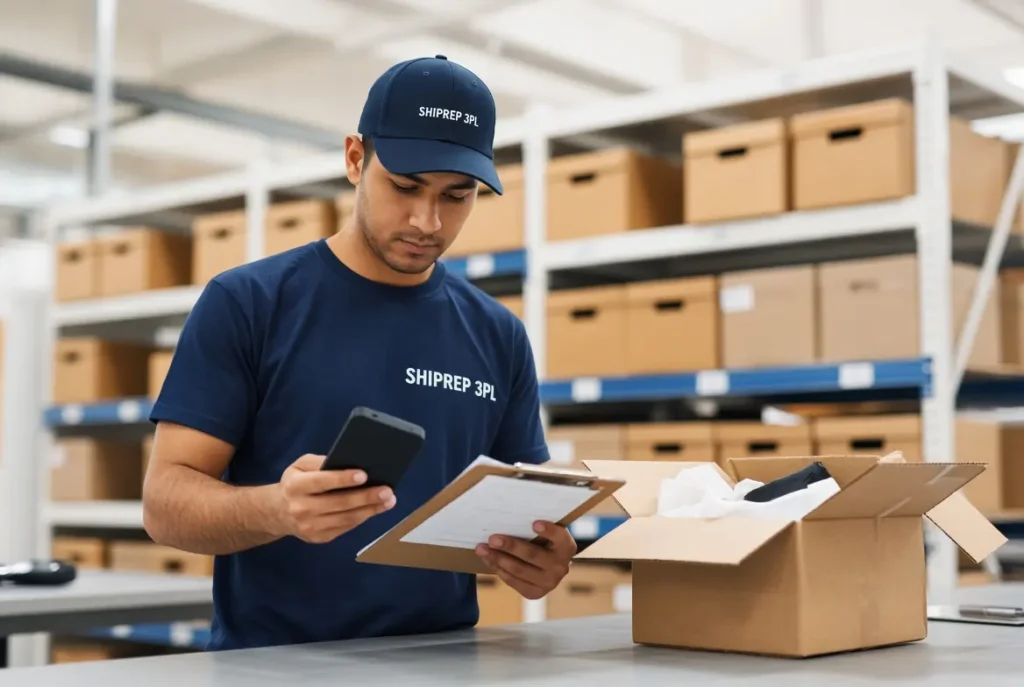
Shiprep processes returns from its warehouse in Bensalem, Pennsylvania, alongside its Amazon FBA prep, labeling, and order fulfillment services. Specifically, returned items get received, inspected, and either repackaged and restocked or handled as directed, so inventory gets back to sellable status without sitting idle. You can see the full service list on the services page.
In addition, Shiprep runs with no advance payment, no setup fee, and no minimum order quantity, which matters for sellers who don’t process enough returns to justify an enterprise contract. To estimate costs, use the pricing calculator, or read about the broader 3PL services for international sellers.
Frequently Asked Questions
What are ecommerce returns processing services?
They cover receiving a returned item, inspecting its condition, and either restocking it, repackaging it, or handling it as damaged, followed by updating inventory and triggering a refund or replacement.
What is the average return rate for ecommerce?
Return rates vary by product category. However, ecommerce returns consistently run higher than in-store retail returns, so a defined process is worth having even at moderate order volume.
Do all 3PLs handle returns?
No. Some 3PLs only handle outbound shipping and don’t offer receiving or inspecting returns. Therefore, confirm this specifically before choosing a provider.
What happens to items after they’re returned?
Typically, a good process inspects the item first, then either restocks it as sellable, repackages it if needed, or sets it aside if it’s damaged or defective.
Is returns handling included in FBA prep services?
Not always. Some prep centers focus only on outbound FBA prep. In contrast, Shiprep processes returns alongside its FBA prep and fulfillment services.
Does Shiprep require a minimum volume?
No. Shiprep operates with no advance payment, no setup fee, and no minimum order quantity.
Get a free quote from Shiprep for ecommerce returns processing services alongside your FBA prep and fulfillment.