
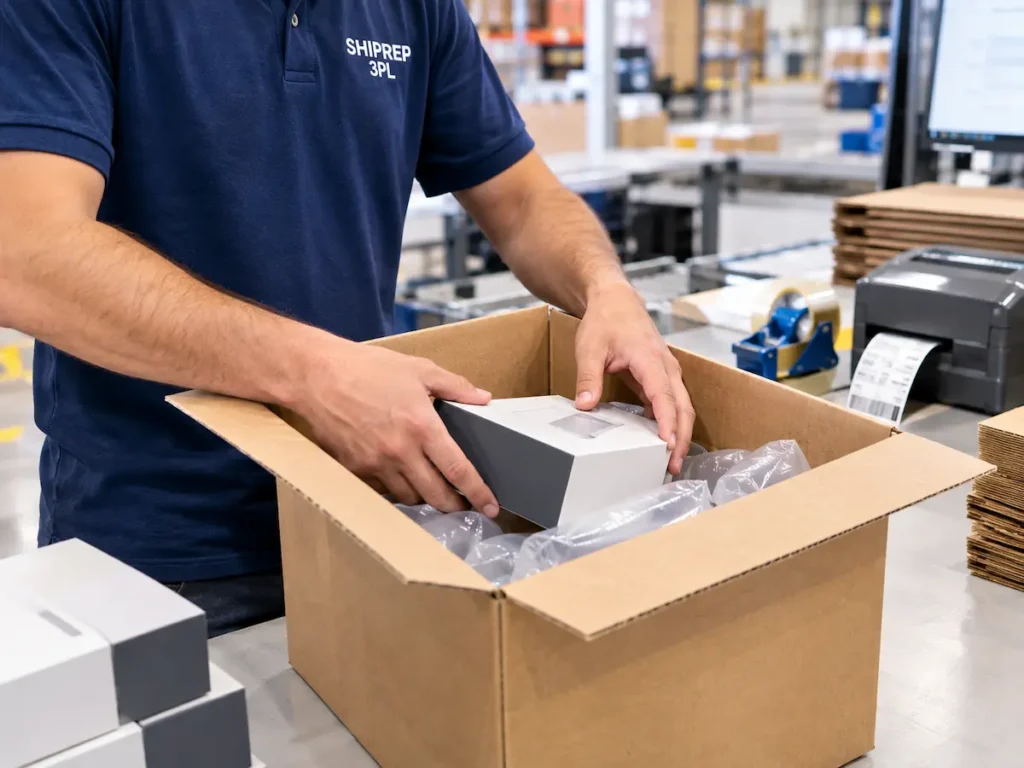
Ecommerce warehouse fulfillment packing means choosing the right box, protective material, and packing method for each product before it ships. The choice depends on the item’s size, fragility, and the carrier’s billing rules. Getting it wrong doesn’t just risk damage. It also triggers dimensional weight surcharges that quietly inflate shipping costs on nearly every order.
Why Packing Decisions Affect More Than Just Damage Rates
Carriers bill by dimensional weight, not just actual weight:
UPS, FedEx, and USPS calculate dimensional weight from a package’s length, width, and height. They divide that figure by a divisor, typically 139 for US domestic shipments in 2026. A 12x12x12 inch box works out to roughly 12.4 lbs of dimensional weight. That’s true regardless of how light the actual product is.
Oversized boxes cost money even when the product is small:
A lightweight item shipped in a too-large box gets billed at the box’s dimensional weight. It doesn’t matter that the product’s real weight is much lower. Right-sizing packaging to the smallest safe box is the most direct way to cut this cost.
Poor packaging drives damage, and damage drives returns.:
Mismatched packaging, like a poly mailer for a fragile item, can push damage rates to 6 to 12% for that category. Each damaged shipment typically costs $10 to $15 in return processing alone. That’s before counting replacement shipping or lost product value.
The Ecommerce Warehouse Fulfillment Packing Process, Step by Step
Product-to-packaging mapping. Every SKU gets matched to a specific box size and protective material. This is based on its dimensions, weight, and fragility, not a handful of generic box sizes.
Picking: The warehouse management system identifies which SKUs an order needs. It directs a picker to retrieve them accurately from storage.
Packing: The picked items go into the pre-mapped packaging. Dunnage gets added only where genuinely needed, since excess dunnage increases box size and dimensional weight.
Sealing and labeling: The package gets sealed, weighed, and measured. It’s labeled with the correct shipping label for the carrier and service level selected.
Quality check: A final check confirms the right product, right quantity, and secure packaging. This matters most for fragile or high-value items, before the box leaves the facility.
Choosing the Right Packing Materials
Boxes. Corrugated boxes remain the standard for most products. Box audits, comparing current sizes against actual product dimensions, routinely surface immediate savings.
Poly mailers: Lightweight and low-cost, but only appropriate for non-fragile, soft goods. Using one for anything breakable is a common, preventable cause of damage claims.
Dunnage and void fill: Air pillows tend to offer better storage density than loose-fill peanuts. Paper-based options like honeycomb wrap now offer a middle ground between protection and a cleaner unboxing experience.
Protective inserts: Custom corrugated or foam inserts matter most for fragile, high-value, or irregularly shaped items. A standard box and dunnage combination often isn’t enough to stop movement during transit.
Packing for Oversized and Heavy Items
Standard high-velocity pick-and-pack workflows aren’t built for large or heavy products. Items over 50 lbs typically trigger carrier “additional handling” surcharges, usually $25 to $40 per package. Items exceeding length-plus-girth thresholds can face oversize penalties between $75 and $150.
Heavy items generate more kinetic energy during warehouse handling and transit. That raises the risk of damage if packing and unitization aren’t handled methodically. A warehouse built for standard parcel volume often lacks the racking and equipment to safely process oversized freight.
What This Means for Amazon, Walmart, and Multi-Marketplace Sellers
Marketplace-specific packaging rules add another layer on top of general best practices. Amazon, for example, enforces its own poly bag thickness and suffocation warning rules. These sit separate from general ecommerce packing standards. A warehouse fulfilling orders across Amazon, Walmart, eBay, and a DTC store needs flexible packing processes. One generic method for every order simply doesn’t work across channels.
How Shiprep Approaches Ecommerce Warehouse Fulfillment Packing
Shiprep handles picking, packing, and shipping from a 3PL warehouse in Bensalem, Pennsylvania. Packaging gets matched to each product and each marketplace’s compliance requirements, not a one-size-fits-all process. You can see the full range of services on our services page.
No advance payment, no setup fee, and no minimum order quantity apply. That’s true whether you’re shipping a handful of orders a month or scaling into the thousands. International sellers can also access purchasing credit and a Pennsylvania reseller tax exemption. Read more in our guide to 3PL prep center services for international sellers. Or run your own numbers with our pricing calculator.
Dimensional weight rules and box specifications can also vary by carrier and destination for international shipments. UPS’s official dimensional weight guidance breaks down exactly how the calculation works across service levels.
Ecommerce Warehouse Fulfillment Packing: Frequently Asked Questions
What is dimensional weight, and why does it matter for packing?
Dimensional weight is a carrier billing method based on a package’s size, not its actual weight. Carriers calculate it from length, width, and height, divided by a set divisor. An oversized box can cost more to ship than a properly sized one. That’s true even with an identical product inside.
What packing mistake most commonly causes product damage?
Using packaging that doesn’t match the product’s fragility. A poly mailer used for a breakable item is one of the most common, preventable causes of transit damage.
Do heavy items need a different packing process than standard parcels?
Yes. Items over roughly 50 lbs typically need different handling and unitization. They also often trigger carrier surcharges. These items generate more force during handling, which raises damage risk if packed like a standard light parcel.
How much can right-sizing packaging actually save?
Savings vary by product and shipping volume. Switching from an oversized box to a properly fitted one can shift a shipment into a lower dimensional weight tier. That effect compounds fast across hundreds or thousands of monthly shipments.
Does Amazon have different packing requirements than general ecommerce shipping?
Yes. Amazon enforces specific rules for poly bag thickness, suffocation warnings, FNSKU label placement, and bundling. These go beyond general ecommerce packing standards, and non-compliant packaging can trigger shipment rejection or per-unit defect fees.
Get a free quote from Shiprep. See how properly matched packing and fulfillment could reduce your shipping costs and damage rate.