
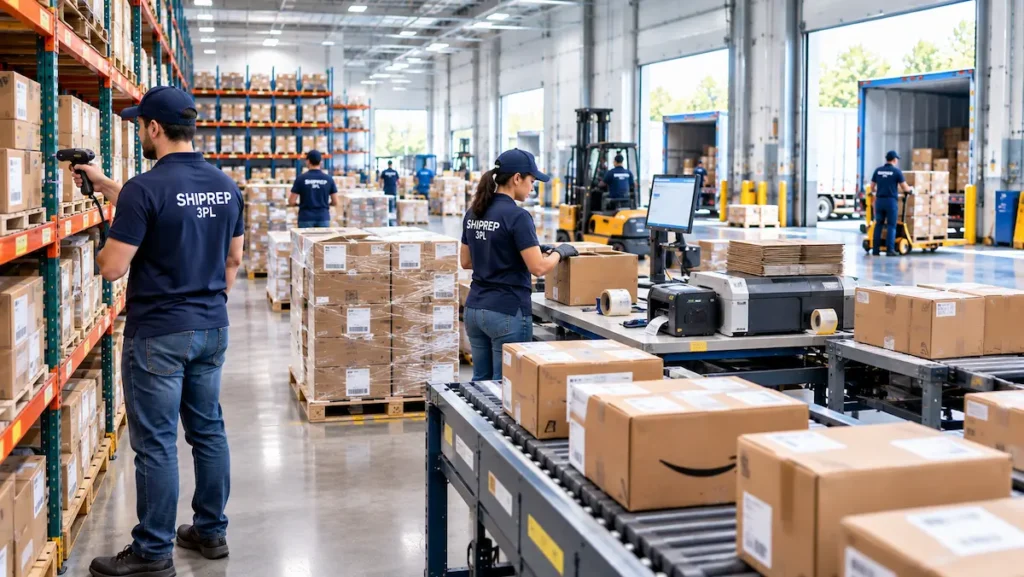
GA 3PL fulfillment services is a company that stores your inventory and handles receiving, picking, packing, and shipping orders on your behalf. Instead of running a warehouse yourself, you send inventory to the 3PL, and they fulfill orders across the marketplaces and channels you sell on, usually billed per unit stored or shipped rather than as a fixed cost.
How 3PL Fulfillment Actually Works
The process follows a consistent sequence regardless of which provider you use:
Inventory arrives and gets checked in: The 3PL receives your shipment from a supplier or freight forwarder, counts it against your packing list, and flags any damage or discrepancies before they become your problem.
Gets prepped for compliance: For marketplace sellers, this means labeling (FNSKU for Amazon, WFS-specific tags for Walmart), poly-bagging, bundling, or kitting, depending on what each channel requires.
Sits in storage until an order comes in: Most 3PLs charge for this by the cubic foot or pallet, either short-term or long-term depending on how fast inventory turns over.
An order triggers picking and packing: The 3PL’s warehouse management system flags which SKUs to pull, a worker picks and packs the order, and it gets labeled for the correct carrier.
The order ships and gets tracked: Once it leaves the warehouse, tracking updates flow back to you and your customer until delivery.
Returns get processed separately: A returned item comes back to the warehouse, gets inspected, and either goes back into sellable inventory, gets flagged for liquidation, or gets discarded, depending on its condition.
The Four Fulfillment Models Compared
Self-fulfillment (merchant fulfillment): You store, pack, and ship every order yourself. This gives full control but doesn’t scale past a few hundred orders a month without significant time and labor cost.
Dropshipping: A supplier ships directly to your customer, and you never touch inventory. This removes storage costs entirely but gives you no control over packaging, shipping speed, or quality.
3PL fulfillment: A third-party warehouse handles storage and shipping for a per-unit fee. This scales with order volume without requiring you to hire warehouse staff or lease space.
Hybrid fulfillment: Some sellers self-fulfill slow-moving or custom items while using a 3PL for high-volume SKUs, balancing control against scale where it matters most.
Why Sellers Switch to a 3PL Fulfillment Service
Order volume outgrows manual capacity
Somewhere between 100 and 2,500 monthly orders, printing labels and packing boxes by hand stops being sustainable, and that time gets pulled directly from marketing, sourcing, or product development.
Demand spikes stop being a crisis
Holiday sales, viral moments, and flash promotions can double or triple order volume overnight.
Shipping costs drop at scale
3PLs negotiate carrier rates across all their clients’ combined volume, which typically beats what an individual seller can get shipping alone.
Multi-marketplace selling gets simpler
Running Amazon FBA, Walmart WFS, eBay, and a Shopify store from one inventory pool is difficult to manage manually, but straightforward for a 3PL built to handle multiple channels from a single warehouse.
What 3PL Fulfillment Doesn’t Solve
You lose some direct control: Packaging quality, pick accuracy, and shipping timing depend on the 3PL’s operations, not yours directly. Choosing a provider with clear SLAs and responsive support offsets most of this risk.
You take on a dependency: If a 3PL has an outage, staffing shortage, or compliance mistake, it affects your business too. This is why contract flexibility (the ability to leave without penalty) matters more than most sellers realize when signing up.
Not every 3PL fits every product: Oversized, fragile, hazardous, or highly custom items need a provider with specific handling capability, not a generic fulfillment warehouse.
What Most 3PL Guides Leave Out
Almost every comparison of 3PL fulfillment services focuses on price per unit and shipping speed. Few address the two things that actually determine whether onboarding goes smoothly: payment terms and marketplace compliance risk.
Payment terms matter more than the rate card: Many 3PLs require a deposit, a setup fee, or a minimum monthly spend before they’ll onboard you. For a seller still validating a product or managing tight cash flow, that upfront cost can matter more than a few cents of difference in per-unit pricing.
Compliance changes are shifting fulfillment responsibility onto sellers. As of January 2026, Amazon stopped handling FBA prep and item labeling for US shipments. That work now sits entirely with sellers and whichever 3PL fulfillment service they use, making prep accuracy a bigger factor in choosing a provider than it was even a year ago.
How Shiprep Approaches 3PL Fulfillment Differently
Shiprep runs 3PL fulfillment services from a single warehouse in Bensalem, Pennsylvania, covering Amazon, Walmart, eBay, Shopify, TikTok Shop, and 150+ other marketplaces. You can see the full service breakdown on our services page.
No advance payment, no setup fee, and no minimum order quantity apply from day one, whether you’re shipping one unit or ten thousand. Sellers running inventory from outside the US can also access purchasing credit up to $100,000 for vendor payments, along with a Pennsylvania reseller tax exemption most 3PLs never mention. The full breakdown is in our guide to 3PL prep center services for international sellers.
You can estimate your own fulfillment costs using our pricing calculator before committing to anything.
3PL Fulfillment Services: Frequently Asked Questions
What does 3PL fulfillment mean?
3PL fulfillment means a third-party logistics provider stores your inventory and handles the picking, packing, and shipping of your orders on your behalf, typically billed per unit stored or shipped.
What is the difference between 1PL, 2PL, 3PL, and 4PL?
A 1PL is a business shipping its own goods directly. A 2PL is a single-service provider like a carrier (UPS, FedEx). A 3PL manages the full fulfillment process, including storage, picking, and shipping. A 4PL manages the entire supply chain strategy, often coordinating multiple 3PLs on a client’s behalf.
Is Amazon a 3PL or a 4PL?
Amazon FBA functions as a 3PL for sellers, since it handles storage, picking, packing, and shipping on their behalf. Amazon doesn’t typically coordinate other providers’ operations, which is the defining trait of a 4PL.
Is DHL a 3PL company?
DHL operates both as a carrier and, through its supply chain division, as a 3PL offering warehousing, fulfillment, and distribution services beyond simple package delivery.
How much do 3PL fulfillment services cost?
Costs typically break into receiving fees, storage (per cubic foot or pallet), pick and pack fees per order, and shipping cost passed through at the carrier rate. Deposit requirements and minimum order quantities vary significantly between providers and often affect total cost more than the per-unit rate does.
Do all 3PLs require a long-term contract?
No, Contract terms vary widely. Some require 6- to 12-month commitments; others operate month-to-month with no lock-in, which matters most for sellers still testing demand for a product.
Get a free quote from Shiprep to see exactly what a 3PL fulfillment service built around transparent terms looks like for your volume.