
Most “3PL warehouse USA” guides come from 3PLs comparing themselves to competitors. They rarely account for one detail that changes the whole decision. That detail: whether you’re actually based in the US or running your business from somewhere else entirely. This guide compares 3PL warehouse USA options through that lens. It also covers the standard criteria every seller should check, regardless of where they’re based.
What International Sellers Need That Domestic Sellers Don’t
A US-based seller can drive to a warehouse, meet the team, and negotiate a contract in person. An international seller can’t. That single difference changes which features actually matter:
Payment flexibility: Wise, PayPal, Payoneer, and wire transfer support matter more than a US bank account requirement. That’s true for any seller operating from outside the country.
No advance payment or high deposits: Tying up capital in a warehouse deposit hits harder when you’ve already absorbed international freight and currency conversion costs.
Tax handling for resellers: Few comparison guides mention state-level reseller tax exemptions. For high-volume sellers, that can matter more than per-unit shipping rates.
Multi-marketplace compliance, not just Amazon: A seller running Amazon, Walmart, eBay, and TikTok Shop from overseas needs one warehouse that handles all four. Four separate vendor relationships isn’t a workable answer.
How the Major 3PL Warehouse USA Providers Compare
Here’s an honest look at how several widely recognized providers stack up. This draws on what each one publishes about itself.
A large, technology-driven network with dozens of US fulfillment centers and dozens of ecommerce platform integrations exists in this space. This type of provider works well for DTC brands that prioritize fast domestic shipping and inventory visibility. It’s built primarily for scale. Smaller or newer sellers may find the onboarding process geared more toward established volume.
Some providers focus on heavy or specialized items. These operate in a small number of US locations and specialize in heavy, oversized, or high-value items, often backed by an accuracy guarantee. This type of provider is a strong fit if your products are bulky or fragile, less so if you need broad marketplace compliance support.
Other providers focus heavily on subscription box brands and DTC ecommerce, with a large partner network across the US.
A few providers position themselves specifically around Amazon and omnichannel brands, with attention to FBA inbound speed.
Some providers target scaling DTC brands specifically. These often carry a higher minimum order volume, though, which can rule out sellers still testing the US market.
None of these providers market themselves specifically to international sellers. None of their public materials mention state tax exemptions, purchasing credit for overseas vendor payments, or a no-deposit onboarding model. That’s the gap Shiprep was built to fill.
Where Shiprep Fits for International Sellers
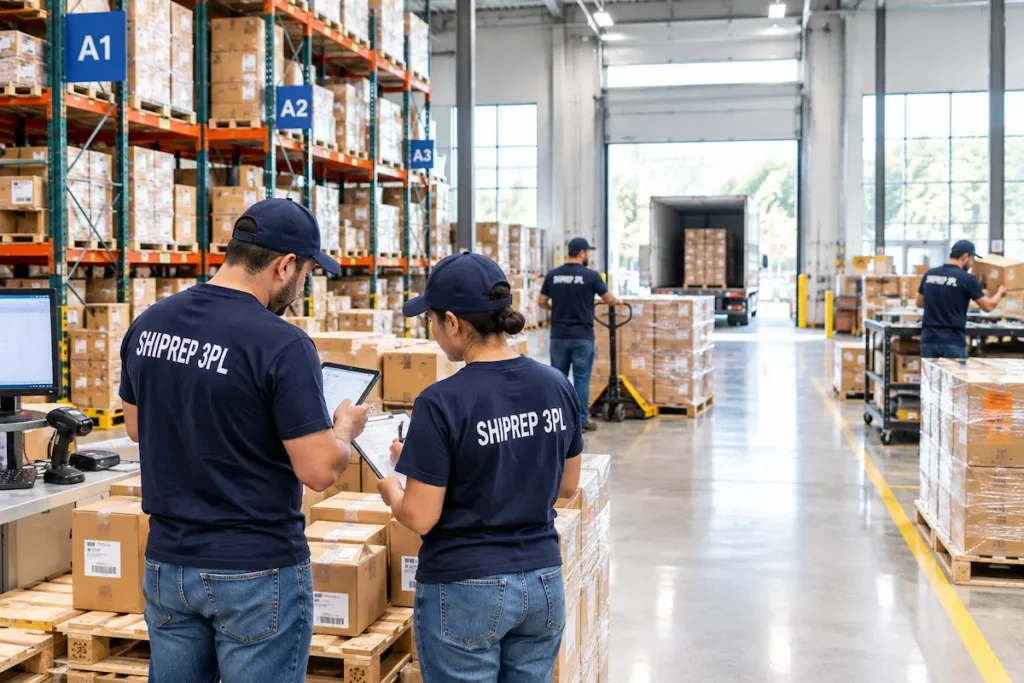
Shiprep runs a single 3PL warehouse in Bensalem, Pennsylvania. It’s built around the specific needs listed above, not general ecommerce fulfillment. You can see the full breakdown of what’s included on our services page.
No advance payment, no setup fee, and no minimum order quantity apply from day one. That’s true whether you’re shipping one unit or ten thousand. International sellers working with overseas vendors can also access purchasing credit up to $100,000. Shiprep pays the vendor directly through domestic banking channels, and you repay through Wise, PayPal, or Payoneer.
Because the warehouse operates in Pennsylvania, resellers can purchase and ship inventory to that address at 0% state sales tax. This applies to international sellers too. You can read the full breakdown in our guide to 3PL prep center services for international sellers.
Multi-marketplace support covers Amazon, Walmart, eBay, Shopify, TikTok Shop, and 150+ other marketplaces from one warehouse. A seller doesn’t need separate vendor relationships for each channel.
Questions to Ask Any 3PL Warehouse USA Provider Before You Commit
Do you require a deposit or setup fee?
If yes, ask exactly what it covers and whether it’s refundable if you leave.
What’s the minimum order quantity?
A high minimum can rule out sellers still testing US demand for a product.
Do you accept international payment methods?
Wise, PayPal, Payoneer, and wire transfer should all be options, not just US ACH.
Which marketplaces do you actually support?
Amazon compliance and Walmart WFS compliance are different processes; confirm the warehouse handles both if you sell on multiple channels. You can check what this looks like in practice with our pricing calculator.
Is there a long-term contract?
Month-to-month terms protect you if service quality drops after you’ve already moved your inventory.
FAQ: Choosing a 3PL Warehouse in the USA
Do all US 3PL warehouses work with international sellers?
No. Many focus on domestic DTC brands. They don’t advertise support for overseas payment methods, cross-border tax questions, or purchasing credit. It’s worth asking directly rather than assuming.
Is a smaller 3PL warehouse worse than a large national network?
Not necessarily. Large networks offer more locations, which helps with domestic shipping speed. A smaller, focused warehouse can offer more flexible terms, lower minimums, and more direct communication instead. Those things often matter more for sellers still growing their US presence.
What’s the biggest mistake sellers make when picking a 3PL warehouse?
Comparing providers on shipping rate alone. Payment terms, contract length, and marketplace compliance support usually matter more. Together, they affect total cost and risk more than a few cents per label.
Can an international seller switch 3PL warehouses without disrupting operations?
Yes, if the new provider has an established transition process. Ask about inventory transfer coordination. Also ask how long the switch typically takes before you commit.
The Bigger Picture
The US third-party logistics market is enormous and growing fast. That scale is exactly why so many providers compete for the same 3PL warehouse USA search terms. Armstrong & Associates tracks the industry closely. Its research puts the US 3PL sector’s annual revenue at tens of billions of dollars across hundreds of providers. That scale means a warehouse exists for nearly every use case. That includes sellers who run their business from outside the United States entirely.
The right choice isn’t the biggest network or the longest feature list. It’s the provider whose terms actually match how and where you operate.
Get a free quote from Shiprep and see how it compares. A US warehouse made for international sellers stacks up differently against the general-purpose options.