
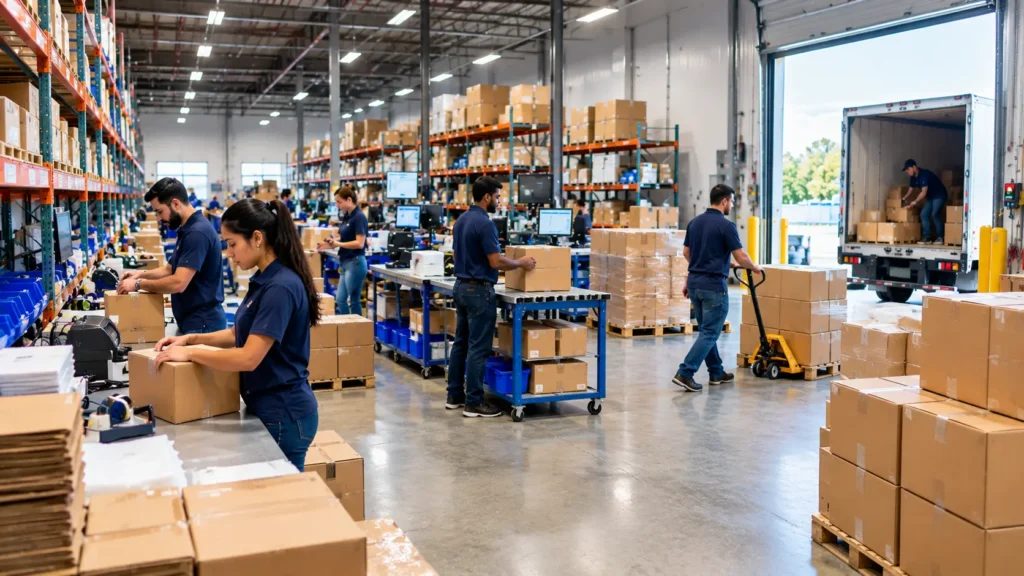
Peak season can account for as much as 40% of an ecommerce seller’s annual revenue, concentrated into a few weeks around November and December. It’s also the window when fulfillment breaks first. Orders spike, carriers slow down, and a warehouse that wasn’t ready by September is still catching up in January. Ecommerce peak season fulfillment comes down to one real question: can your provider absorb the spike without you committing to volume you don’t carry the rest of the year?
Why Peak Season Breaks Fulfillment First
Most fulfillment problems that show up in Q4 aren’t new problems. They’re normal-season weak points that get amplified by volume.
- Order volume jumps fast. A seller doing 300 orders a month in August can see 800 to 1,000 in late November. Any manual step in your process- label printing, pick lists, inventory counts- gets slower exactly when speed matters most.
- Carriers add surcharges and slow down. USPS, UPS, and FedEx all apply peak season surcharges, and transit times stretch as their own networks get saturated. A 2-day delivery promise in October can quietly become 4 days in December if nothing on your end changes.
- Inventory errors cost more. A mislabeled FBA shipment or a missed Walmart WFS compliance check doesn’t just cause a delay during peak season; it can mean a lost Buy Box, a stranded shipment, or a customer who buys from someone else instead of waiting.
- Returns surge right after. The same spike that hits shipping in December hits returns processing in January. A provider that handles outbound well but has no real returns process leaves a gap exactly when it matters.
None of this is solved by working faster in December. It’s solved by having a fulfillment setup that doesn’t need to change shape when volume does.
What to Check Before Peak Season Hits
Ask these questions in September or October, not in the middle of a volume spike:
- Does the provider require a volume commitment that doesn’t match your normal monthly orders? Many 3PLs size their minimums around steady, predictable volume. If your business is naturally seasonal, a flat monthly minimum either overcharges you in slow months or doesn’t cover your peak needs.
- What’s the real turnaround time from receiving to dispatch during high-volume periods? A provider’s advertised 24-48 hour turnaround often slips during peak season. Ask specifically how that number changes in Q4, not just what it is in a slow month.
- Can it handle every channel you sell on from the same inventory pool? If you’re running Amazon FBA, Walmart WFS, and a Shopify store separately, peak season is when the cracks between disconnected inventory systems show up as overselling or stockouts.
- Is pricing per unit, or does it spike unpredictably at higher volume? Transparent per-unit pricing means your peak season costs scale with your peak season revenue. A provider that adds unclear surcharges at volume makes your margins harder to plan around.
- How does it handle the returns surge after peak season ends? Ask this before peak season starts, since it’s the question most sellers forget until January.
A Realistic Peak Season Timeline
Most experienced sellers work backward from the peak, not forward from today:
- 60-90 days out: Confirm your fulfillment provider can handle projected volume, and resolve any minimum-order or contract questions before you need the answer urgently.
- 30-45 days out: Send inventory in ahead of the rush. Warehouses and fulfillment centers alike get congested closer to peak, and earlier shipments clear faster.
- During peak: Monitor turnaround times weekly, not just at the start. A provider that was fast in week one of peak season can slow down by week four if volume keeps climbing.
- After peak: Plan for the returns increase that follows, typically through mid-to-late January.
Shiprep for Ecommerce Peak Season Fulfillment
Shiprep handles Amazon FBA prep, Walmart WFS prep, Shopify fulfillment, labeling, bundling, order picking and packing, and returns processing from the East Coast of the USA. Because pricing runs with no advance payment, no setup fee, and no minimum order quantity, scaling up for peak season and scaling back afterward doesn’t require a new contract or a different pricing tier. The same account structure that works in a slow month works during a volume spike.
For sellers running multiple channels, the full services page covers everything handled in one warehouse, and the guide to multi-channel order fulfillment explains how Amazon, Walmart, and Shopify orders run through a single inventory pool. Estimate costs for your expected peak volume with the pricing calculator.
FAQs
When should I start preparing for ecommerce peak season fulfillment?
Most sellers start 60 to 90 days out, giving both inventory and a fulfillment partner enough lead time to be ready before volume actually spikes.
Does peak season fulfillment require a different 3PL than the rest of the year?
Not if the provider scales with volume without requiring a separate minimum, contract, or pricing tier specifically for peak months.
How much does order volume typically increase during peak season?
It varies by category, but many sellers see volume roughly double to triple compared to a normal month, concentrated into just a few weeks.
What’s the biggest fulfillment mistake sellers make during peak season?
Waiting until volume has already spiked to address a minimum-order limit, a slow turnaround time, or a disconnected multi-channel inventory setup, instead of confirming those details in advance.
Does Shiprep require extra fees or a separate contract for peak season volume?
No. Shiprep operates with no advance payment, no setup fee, and no minimum order quantity year-round, including during peak season.
Get a free quote from Shiprep before peak season volume hits, so your fulfillment setup is ready ahead of the spike.
For broader peak season planning guidance, see Amazon’s official holiday readiness resources for sellers.