
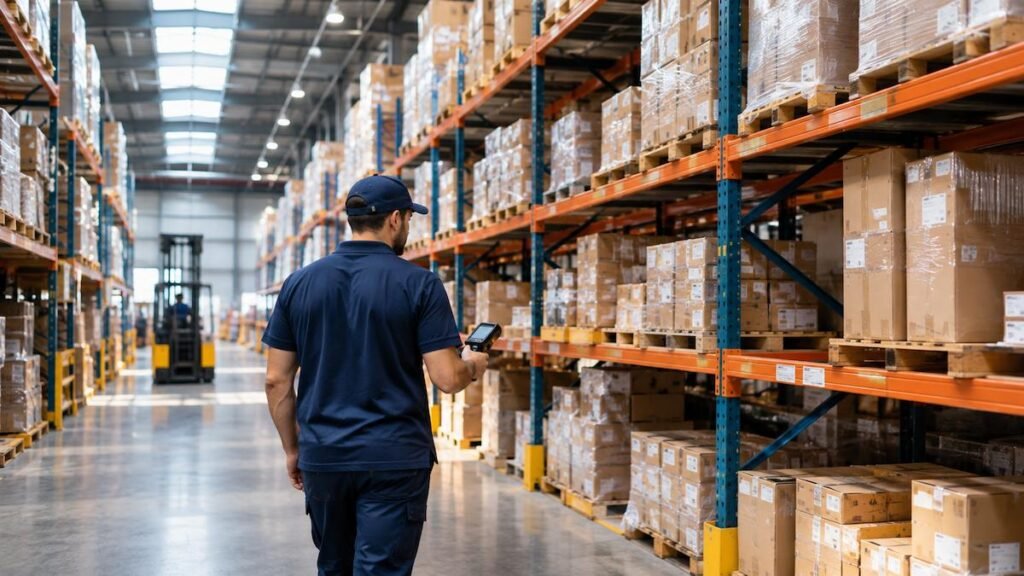
A 3PL logistics company for ecommerce handles storage, picking, packing, and shipping for a business. It charges a per-unit or per-order fee instead of a fixed cost. The real question most sellers need answered isn’t what a 3PL does. It’s whether outsourcing actually costs less than doing it yourself, and at what point that math changes.
The Real Cost of Fulfilling Orders In-House
Labor isn’t cheap, and it doesn’t scale down. Warehouse labor costs average $15 to $22 per hour, plus benefits. That cost applies whether you’re processing 50 orders a day or 500. It doesn’t shrink during slow weeks the way a per-order 3PL fee does.
Warehouse space costs money even when it’s half empty. The national average asking rent for U.S. industrial space is $10.18 per square foot per year in 2026. A seller leasing space for peak-season capacity pays that same rent in the slow months too.
Peak season breaks in-house operations first. Nearly half of online shoppers expect delivery within two days. Meeting that expectation during a demand spike, without dedicated logistics infrastructure, is where most in-house fulfillment starts to crack.
What Outsourcing to a 3PL Logistics Company Actually Changes
Fixed costs become variable costs. Instead of paying rent and salaries regardless of order volume, you pay per unit stored and per order shipped. Costs move up and down with actual demand.
Shipping zones and delivery speed improve. A 3PL with multiple warehouse locations can store inventory closer to customers. Packages travel through fewer shipping zones. That often lowers carrier rates and delivery time together.
Peak season becomes the 3PL’s problem to solve. A provider serving hundreds of clients has already built the infrastructure to absorb demand spikes. An individual seller building that same capacity, just for a few weeks a year, rarely makes financial sense.
When In-House Fulfillment Still Makes Sense
Very low order volume. At a few dozen orders a week, a 3PL’s per-unit cost can exceed what it costs to pack orders yourself in spare time.
Highly custom or personalized products. Items needing hands-on customization at the point of packing are harder to hand off without losing quality control.
Existing warehouse capacity you already pay for. If you already lease space and employ staff for other reasons, in-house fulfillment’s marginal cost can be lower than starting from zero.
How to Actually Evaluate a 3PL Logistics Company
Ask for real pricing, not a range. A quote based on your actual product dimensions, weight, and order volume matters more than a generic per-unit estimate.
Check for hidden fees. Receiving, storage, pick-and-pack, and shipping costs should all be itemized separately, not bundled into one vague number.
Confirm contract flexibility. A 3PL that locks you into a 12-month contract carries more risk than one running month-to-month. This matters most if you’re still validating demand.
Ask about deposits and minimums. Some 3PLs require an advance payment or a minimum order quantity before onboarding. That upfront cost affects total cost just as much as the per-unit rate.
Confirm which platforms and services are actually covered. A provider’s core service list should match what you sell on — labeling, bundling, order picking and packing, and returns handling are the essentials to check for.
How Shiprep Fits Into This Decision
Shiprep operates as a 3PL logistics company for ecommerce sellers, from a warehouse in Bensalem, Pennsylvania. Its services cover labeling and tagging for Amazon FBA and Shopify, packaging and bundling, order picking and packing, return processing, and Amazon FBA prep. You can see the full service breakdown on the services page.
No advance payment, no setup fee, and no minimum order quantity apply from day one. That’s true whether you’re shipping ten orders a month or ten thousand. International sellers can also access purchasing credit and a Pennsylvania reseller tax exemption. Read the details in the guide to 3PL prep center services for international sellers. Or run your own numbers with the pricing calculator.
Armstrong & Associates tracks 3PL market data closely. Their published figures offer broader context on the industry’s growth, updated each year.
3PL Logistics Company for Ecommerce: Frequently Asked Questions
What is a 3PL in ecommerce?
A 3PL, short for third-party logistics, is a company that stores an ecommerce business’s inventory and handles receiving, picking, packing, and shipping orders on its behalf, typically billed per unit or per order.
Is a 3PL the same as a warehouse?
Not exactly. A warehouse is just storage space. A 3PL logistics company runs a warehouse plus the operational services around it, including order fulfillment, shipping, inventory management, and often returns handling.
What’s the difference between 3PL and 4PL?
A 3PL manages the physical fulfillment process directly, including storage, picking, and shipping. A 4PL manages the broader supply chain strategy, often coordinating multiple 3PLs and carriers on a client’s behalf rather than running fulfillment itself.
Is a 3PL cheaper than fulfilling orders in-house?
It depends on volume. At low order counts, in-house fulfillment can be cheaper. Once labor, rent, and peak-season strain add up, a 3PL’s variable, per-order pricing often becomes more cost-effective.
How do I know if a 3PL logistics company is a good fit for my ecommerce business?
Compare real, itemized pricing based on your actual product and volume. Then check contract flexibility, deposit requirements, and which services and platforms the provider actually supports.
Do all 3PL logistics companies charge a deposit to get started?
No. Terms vary significantly between providers. Some require a deposit or minimum order quantity. Others, including Shiprep, onboard sellers with no advance payment and no minimum.
Get a free quote from Shiprep. Compare the real numbers against what in-house fulfillment is actually costing you.