
Ecommerce order accuracy and quality control determine whether a customer gets exactly what they ordered, every time. Top-performing fulfillment operations hit 96 to 98% order accuracy. Each error below that benchmark costs more than one reshipment. It costs a customer’s trust in your brand.
What Order Accuracy Actually Measures
Order accuracy is the percentage of orders shipped with the correct product, quantity, variant, condition, packaging, and label. A single wrong item, even in an otherwise perfect shipment, counts as an inaccurate order.
Top performers hit 96 to 98% accuracy. Below that range, errors start compounding into real cost: return shipping, replacement units, customer service time, and in some cases, marketplace account penalties.
What Drives Order Accuracy Down
Inconsistent SKU and location data. If a warehouse management system shows a product in the wrong bin, a picker grabs the wrong item, however careful they are.
No verification step at pick or pack. Without a checkpoint confirming the right item before it ships, small picking errors slip through undetected.
Manual processes at scale. Hand-written pick lists and manual double-checks work at low volume. They break down fast once order counts climb.
Poor visual inspection. Products that look similar, or come in multiple variants, need a deliberate check beyond just grabbing the right shelf.
How Quality Control Actually Catches Errors Before They Ship
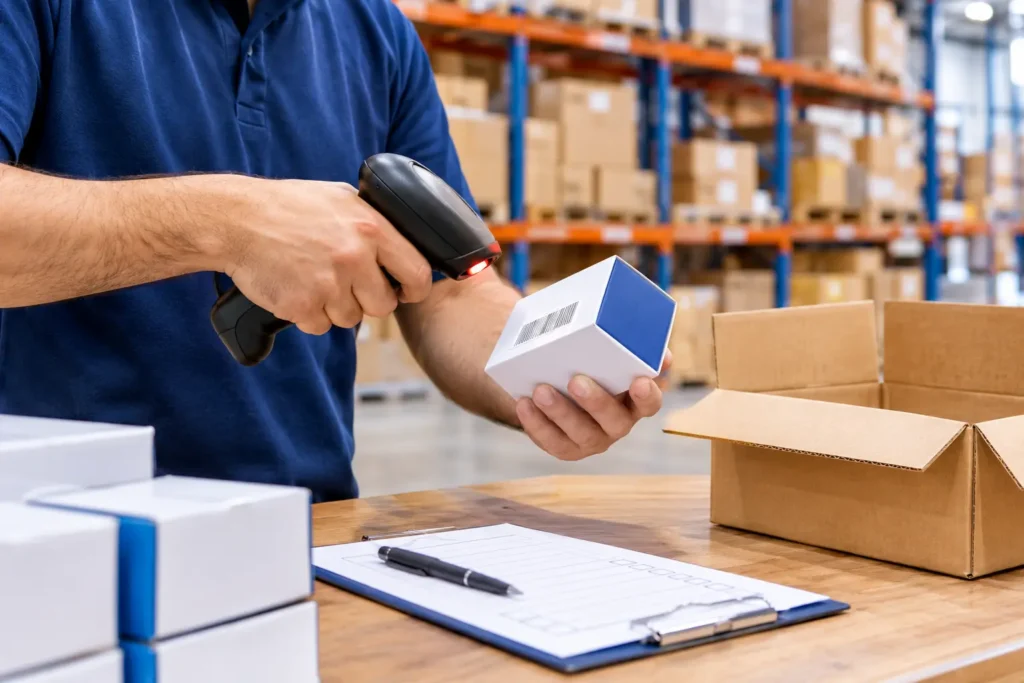
Barcode scanning at pick. Scanning each item against the order confirms the right SKU before it leaves the shelf, catching mismatches instantly rather than after the fact.
Pick verification built into the workflow. A second check, whether automated or manual, confirms quantity and variant match the order before packing begins.
Visual inspection at pack. For products prone to confusion, a quick visual check adds a layer scanning alone doesn’t always catch.
Inbound inspection, not just outbound. Catching a labeling or quantity issue when inventory arrives prevents that error from ever reaching a customer order later.
Why This Matters More for Multi-Marketplace Sellers
A seller running Amazon, Walmart, eBay, and Shopify from one inventory pool faces more variables than a single-channel operation. Different marketplaces, different packaging rules, and different SKU mapping all raise the chance of an error if quality control isn’t consistent across every channel, not just the biggest one.
How Shiprep Approaches Order Accuracy and Quality Control
Shiprep counts and inspects every inbound shipment, with photo and video documentation, before it’s stored or prepped. Outbound orders go through pick, pack, and ship with the same attention, from our warehouse in Bensalem, Pennsylvania. You can see our full range of services on our services page.
No advance payment, no setup fee, and no minimum order quantity apply to any of our services. You can read more about our picking and packing process in our guide to ecommerce 3PL picking and packing, or estimate your fulfillment costs with our pricing calculator.
For a broader look at industry-standard fulfillment KPIs beyond accuracy alone, Oracle NetSuite’s guide to order accuracy covers how it connects to inventory data and broader operational metrics.
Ecommerce Order Accuracy and Quality Control: Frequently Asked Questions
What is considered a good order accuracy rate?
Top-performing fulfillment operations typically hit 96 to 98% order accuracy. Rates below that range usually signal gaps in verification or SKU management worth addressing.
What’s the difference between order accuracy and quality control?
Order accuracy is the measurable outcome, the percentage of correctly fulfilled orders. Quality control is the process, like barcode scanning and pick verification, used to achieve that outcome.
Does barcode scanning alone guarantee order accuracy?
No. Scanning catches SKU mismatches effectively, but visual inspection and pick verification catch issues scanning alone can miss, like damaged items or incorrect quantities within a correct SKU.
Why do order accuracy problems get worse at higher volume?
Manual processes that work at low volume, like handwritten pick lists, don’t scale. Without automated verification, error rates tend to climb as order counts increase.
How does order accuracy affect marketplace seller metrics?
Repeated fulfillment errors can trigger returns, negative reviews, and in some cases account-level performance issues on marketplaces like Amazon, beyond just the direct cost of the mistake itself.
Get a free quote from Shiprep to see how our quality control process protects your order accuracy at scale.