
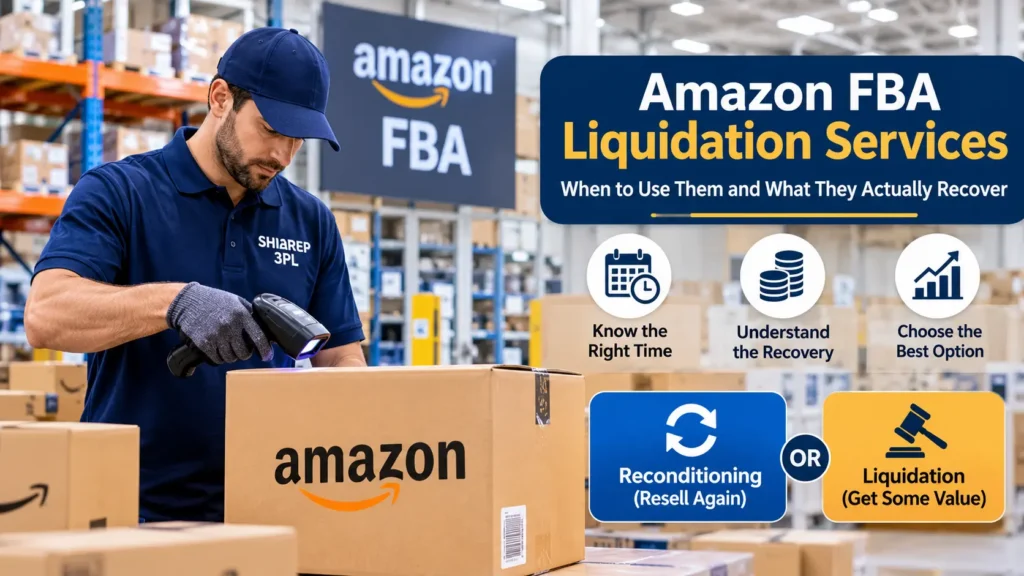
Amazon FBA liquidation services help sellers recover some value from slow-moving, excess, or returned inventory. This avoids paying mounting storage fees on stock that isn’t selling. Timing matters as much as the decision itself. Amazon’s aged inventory surcharges start kicking in well before most sellers expect. The earlier you act, the more value there is left to recover.
When Inventory Actually Needs Liquidating
Sell-through has stalled. A sell-through rate below 1.0, tracked over two or three consecutive checks, signals inventory accumulating faster than it sells. That’s a stalled SKU, not a slow week.
The aged inventory surcharge is approaching. As of January 2026, Amazon’s aged inventory surcharge begins at 181 days in FBA for most standard-size products. For clothing, shoes, bags, jewelry, and watches, it’s 271 days.
Storage costs are climbing past the product’s value. Inventory aged 12 to 15 months faces an extra $0.15 to $0.30 per unit per month. Past 15 months, that rises to $0.35 per unit or $7.90 per cubic foot, whichever is higher.
Your IPI score is getting squeezed. Slow-moving SKUs sitting in storage can tighten your account’s overall capacity. That can block a bestseller from being restocked even when demand is there.
What Amazon’s Own FBA Liquidation Services Actually Pay
Amazon’s FBA Liquidation Program resells excess inventory through its own liquidation buyers. It’s fast and requires no extra effort from the seller. Typical recovery sits at 5 to 20% of the product’s original value. That covers a fraction of what was spent on the inventory and its storage.
For sellers who want more control or a better recovery rate, alternatives exist outside Amazon’s built-in program. This includes third-party liquidation and reconditioning services run through a 3PL.
Removal Orders vs. Liquidation: Choosing the Right Path
Removal orders return inventory to you or dispose of it. They typically take 10 to 14 business days to process. This makes sense when the inventory still has resale value elsewhere, like your own store, a different marketplace, or after reconditioning.
Liquidation sells the inventory off at a steep discount, immediately converting dead stock into some cash. This makes more sense for inventory that’s genuinely unsellable at any reasonable price, or close to it.
The right call usually comes down to one question. Is this inventory still sellable somewhere, in some form, or is holding onto it just delaying the inevitable?
Why Reconditioning Often Beats Straight Liquidation
Inventory removed from FBA for damage, expired labeling, or other issues isn’t necessarily dead stock. In many cases, it just needs cleaning, repair, or relabeling to become sellable again. That could mean back on Amazon or through another channel.
Straight liquidation through Amazon’s program recovers 5 to 20% of value. Reconditioning and reselling inventory, where it’s realistically possible, often recovers significantly more. The product goes back to market near its original price instead of a clearance rate.
How Shiprep Handles Stalled and Removed Inventory
Shiprep offers recovery and reconditioning services for inventory removed from FBA. We clean, repair, and relabel it to make it sellable again. We also offer liquidation services for inventory that’s genuinely past the point of reselling. You can see the full range of services on our services page.
No advance payment, no setup fee, and no minimum order quantity apply to any of our services. International sellers can also access purchasing credit and a Pennsylvania reseller tax exemption. Read more in our guide to 3PL prep center services for international sellers. Or estimate costs with our pricing calculator.
For the current, official aged inventory surcharge rates and thresholds, Amazon’s Seller Central fee schedule is the most accurate source, since these rates do get updated.
Amazon FBA Liquidation Services: Frequently Asked Questions
When should I liquidate FBA inventory instead of holding onto it?
Liquidate when sell-through has stalled for two or more consecutive checks. Also consider it when the aged inventory surcharge is approaching 181 or 271 days, or storage costs are on track to exceed what the inventory is worth.
How much does Amazon FBA liquidation services program actually pay back?
Typical recovery through Amazon’s own FBA Liquidation Program is 5 to 20% of the product’s original value. Liquidation buyers buy the inventory at a steep discount.
What’s the difference between a removal order and liquidation?
A removal order gets inventory back to you, or disposes of it, usually within 10 to 14 business days. Liquidation sells it off immediately at a steep discount through Amazon or a third party.
Can removed FBA inventory be sold again instead of liquidated?
Often, yes. Inventory removed for damage, labeling issues, or other fixable problems can sometimes be cleaned, repaired, and relabeled. It can then be resold near its original price instead of liquidated at a steep discount.
How does the aged inventory surcharge affect the liquidation decision?
Once storage costs start exceeding the inventory’s likely sale value, holding onto it stops making financial sense. Comparing the surcharge trajectory against realistic resale value is the clearest way to time a liquidation decision.
Get a free quote from Shiprep to see whether your stalled inventory is a better fit for reconditioning or liquidation.