
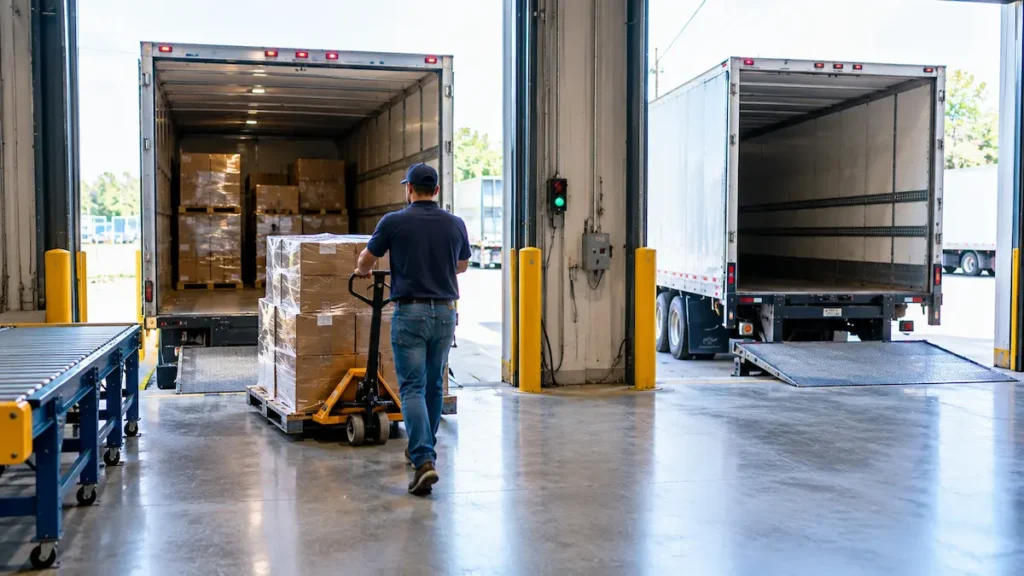
Crossdocking services for ecommerce move inventory straight from an inbound truck to an outbound shipment, with little or no time spent in storage. A cross-docked shipment gets sorted and reloaded within hours of arrival, instead of being shelved and picked later. For the right product mix, that difference can cut both cost and delivery time significantly.
How Crossdocking Actually Works
A shipment arrives at the warehouse dock. Instead of being scanned into storage, it gets sorted immediately. It’s often consolidated with other inbound freight headed to the same destination, then loaded onto an outbound truck. The entire process typically happens within the same day, sometimes within hours.
Traditional warehousing follows a longer path. Unload, scan, assign a storage location, hold for days or weeks, then pick and pack when an order comes in. Crossdocking removes the storage and putaway steps entirely.
The Real Cost and Speed Impact of Crossdocking Services for Ecommerce
Storage costs drop significantly. Eliminating long-term storage typically cuts warehousing costs by 20-30%. High-volume operations can see savings closer to 50%.
Labor costs fall too. Removing the putaway and picking steps can lower labor expense per unit by up to 30%, since fewer touches mean less handling time per shipment.
Delivery speeds up. Lead times can shrink by up to 40% compared to standard warehousing, since product skips the storage-and-retrieval cycle entirely.
Transportation gets more efficient. Consolidating shipments from multiple inbound sources into fuller outbound loads cuts transportation spend. The typical range is 15 to 20%.
Damage risk drops. Fewer touchpoints between receiving and shipping means fewer chances for a product to get dropped, mishandled, or damaged in storage.
Types of Crossdocking
Pre-distribution crossdocking. The receiving warehouse already knows which outbound shipment each item belongs to. This is based on existing orders, set before the shipment even arrives.
Post-distribution crossdocking. Inventory arrives without a predetermined destination. The warehouse determines allocation based on real-time demand after receiving it.
Consolidation crossdocking. Multiple smaller shipments from different suppliers get combined into one larger outbound shipment. This is common for ecommerce sellers working with multiple vendors.
Continuous crossdocking. Goods move through the facility in a constant, high-frequency flow rather than discrete batches, typically used for very high-volume, fast-moving products.
When Crossdocking Makes Sense, and When It Doesn’t
Good fit: High-volume, fast-moving products with predictable demand. Bulk inventory already allocated to specific orders. Time-sensitive goods where speed matters more than flexible storage.
Not a good fit: Slow-moving or seasonal products with unpredictable demand. Items needing quality inspection, repackaging, or kitting before they ship. Businesses that need the flexibility to hold inventory and respond to shifting order patterns over weeks or months.
Most ecommerce sellers end up using a mix. Fast-moving, high-confidence SKUs get cross-docked, while slower or less predictable inventory goes through standard storage and fulfillment.
How Shiprep Approaches Crossdocking
Shiprep offers crossdocking as part of its broader 3PL services, alongside standard storage, kitting, and multi-marketplace fulfillment, from our warehouse in Bensalem, Pennsylvania. You can see the full range of services on our services page.
The right fit between crossdocking and standard warehousing depends heavily on your product mix and order patterns. Our team can walk through your volume and SKUs directly to confirm what makes sense. No advance payment, no setup fee, and no minimum order quantity apply to any of our services. International sellers can read more in our guide to 3PL prep center services for international sellers. Or estimate costs with our pricing calculator.
Crossdocking Services for Ecommerce: Frequently Asked Questions
What is the main difference between crossdocking and warehousing?
Crossdocking moves inventory directly from inbound to outbound transport with little or no storage time. Traditional warehousing stores inventory for days, weeks, or months before it gets picked for an order.
How much can crossdocking actually save on costs?
Storage costs typically drop 20 to 30% by eliminating long-term warehousing. Labor costs can fall by up to 30% by removing the putaway and picking steps. Exact savings depend on volume and product type.
Is crossdocking only useful for very large businesses? No, but it works best for sellers with consistent, high-volume, predictable demand on specific SKUs. Smaller sellers with variable order patterns often do better with a mix of crossdocking and standard storage.
Can crossdocking work alongside normal warehouse storage? Yes. Many ecommerce sellers use crossdocking for fast-moving, high-confidence inventory while keeping slower or less predictable products in standard storage and fulfillment.
Does crossdocking increase the risk of stockouts? It can, if demand forecasting isn’t accurate, since crossdocked inventory isn’t held as a buffer the way warehoused stock is. Accurate forecasting is essential to making crossdocking work without running short.
For a deeper technical breakdown of how cross-docking terminals operate, Wikipedia’s overview of cross-docking covers the industry’s standard definitions and terminology.
Get a free quote from Shiprep to find out whether cross-docking fits your product mix and order volume.